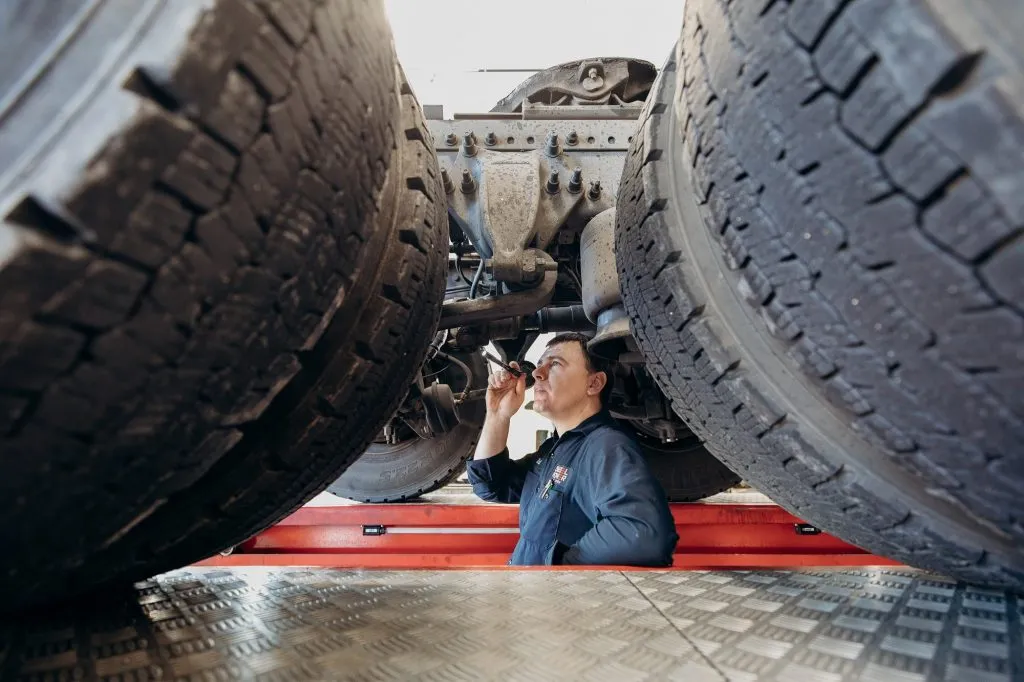
Every roadside inspection your trucks will face this year traces back to one procedure. The North American Standard Level I inspection is a 37-step examination of both the driver and the vehicle, and it is the backbone of CVSA’s annual International Roadcheck enforcement event, as described in CVSA’s 2026 Roadcheck announcement. The latest published Roadcheck results show exactly where trucks fail, which means they also show where your maintenance hours should go before dispatch.
What a Level I inspection covers
The procedure splits into two halves. The driver portion deals with the person behind the wheel and their paperwork. The vehicle portion is a mechanical walk-around and under-vehicle check that, per CVSA, covers brakes, cargo securement, coupling devices, driveline components, fuel and exhaust systems, the frame, lighting, steering, suspension, tires, wheels, rims, hubs, and wipers. If you have ever wondered why a full inspection takes as long as it does, the answer is that 37 steps cover a lot of hardware, from the steering box on the tractor to the rearmost lamp on the trailer.
That split matters for planning, because the two halves fail at very different rates, and only one of them can be fixed in a shop bay ahead of time.
The numbers from the last published Roadcheck
One caution before the data. Roadcheck 2026 was held in May, but CVSA has not yet published its results, so any 2026 Roadcheck findings you see quoted right now are guesses. The latest official picture is the 2025 event, and CVSA’s published 2025 results are detailed enough to build a checklist on.
In the 2025 event, inspectors completed 56,178 inspections. The vehicle out-of-service rate was 18.1 percent, while the driver out-of-service rate was 5.9 percent. Narrowing to the 44,435 Level I, II, and V vehicle inspections, 10,064 vehicle combinations, or 22.6 percent, were placed out of service.
Read those rates side by side and the takeaway writes itself. Vehicle defects park trucks at roughly three times the rate of driver violations, and nearly one in four vehicles that received a full vehicle inspection did not drive away from it. Driver compliance still matters, but the mechanical side is where preparation pays off, and it is the side a shop can address before the truck ever meets an inspector. That is the core argument for treating the shop, not the scale house, as the place where inspection outcomes get decided.
Brakes are still the number one reason trucks get parked
Brake-system violations accounted for 3,304 vehicle out-of-service violations in the 2025 event, and the 20 percent defective-brake category added 2,257 more. Together, brake categories represented 41.1 percent of all vehicle out-of-service violations. Two of every five parked trucks were parked over brakes.
The shop-floor translation is that brake work belongs on a measured schedule, not a complaint-driven one. Pushrod stroke measured at every position, linings checked for thickness and contamination, hoses traced for chafing, and drums and rotors inspected for cracks and heat damage. None of that is exotic work. It is routine work that too often waits until a driver reports a pull or a slow air build, which is usually well after an inspector would have flagged it.
Tires are the second biggest category
Tire violations came in at 2,899 in the 2025 results, or 21.4 percent of vehicle out-of-service violations. Tread depth, inflation, and sidewall condition are about the cheapest things on a truck to check and about the most expensive to ignore, because a tire out-of-service condition strands the load wherever the inspection happens. While the truck is in the bay, have wheels, rims, and hubs looked at in the same visit, since they live in the same corner of the vehicle and carry the same heat and load stresses.
Update your checklist to the 2026 criteria
Do not run 2026 inspections against an old checklist. CVSA’s 2026 out-of-service criteria, published April 1, 2026, added or revised conditions involving brake hoses, linings, wire rope, upper couplers, and cracked rims. A vehicle that would have cleared under last year’s criteria can be written up under the current ones, so whoever inspects your equipment needs to be working from this year’s book.
The wire-rope and upper-coupler changes matter for specific equipment, but the brake-hose and lining revisions touch nearly every combination vehicle on the road. If your PM sheet has not been revised since last year, updating it is the first piece of maintenance to do, before any wrench touches the truck.
A practical pre-dispatch checklist
Split the work the way the inspection splits it.
Driver walk-around, every trip:
- All lighting working, lenses intact and clean
- Tires checked with a gauge, plus a look at sidewalls and between duals
- Listen for air leaks with the system charged and brakes applied
- Cargo securement tight, with tie-downs matched to the load
- Coupling area checked, kingpin and fifth wheel engaged, gladhands seated
- Wipers and washers functional
Shop inspection, on a set interval:
- Brake stroke measured at every wheel position and slack adjusters verified
- Linings, drums, and rotors inspected against current limits
- Hoses and tubing traced for chafing and contact points
- Steering and suspension components checked for play, cracks, and shifted parts
- Wheels, rims, and hubs examined for cracks and leaks
- Driveline, fuel and exhaust systems, and frame inspected from underneath
The driver list catches what changes day to day. The shop list catches what develops over weeks, which is exactly the kind of defect that produced an 18.1 percent vehicle out-of-service rate last year. Run both consistently and a Level I stop becomes paperwork instead of a problem.
Diesel Power Truck Center runs full truck and trailer inspections in Asheville, NC, covering brakes, tires, steering, suspension, and the rest of the Level I vehicle list, with repairs handled in the same visit where possible. To put your equipment through a proper inspection before it meets an inspector, contact our team to schedule.