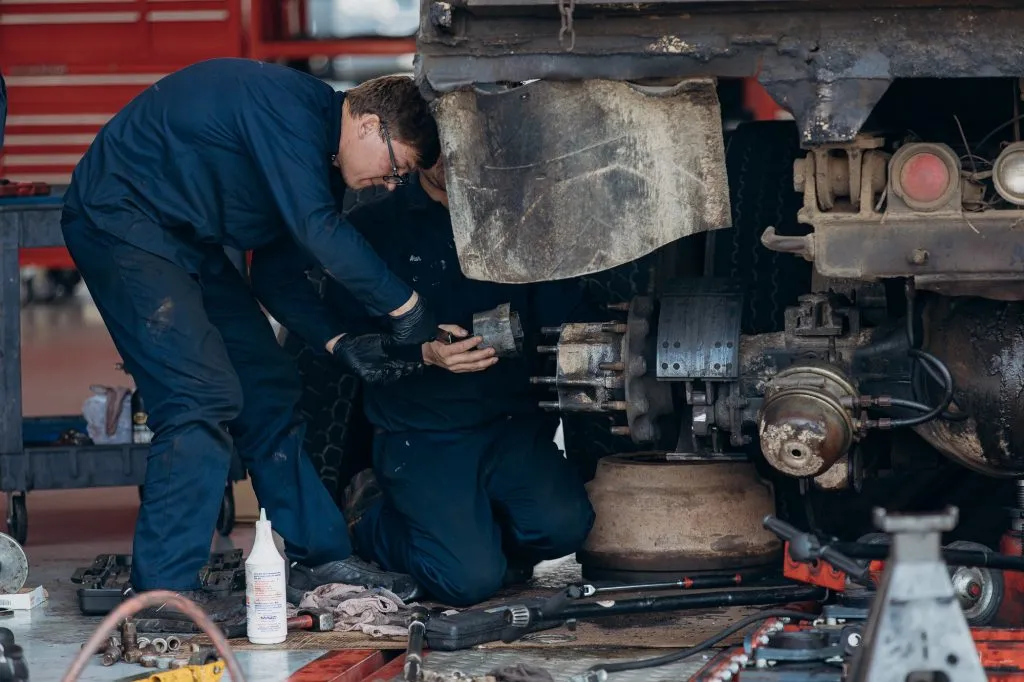
The Commercial Vehicle Safety Alliance has set Brake Safety Week for August 23-29, 2026, and this year inspectors will put special focus on brake drums and rotors. For Asheville fleets and owner-operators, that is a hard deadline. Any brake work you want done before enforcement week needs to be found, parts ordered, and repairs finished in the coming weeks, not the Friday before.
What inspectors will focus on this year
CVSA announced the dates and the drum-and-rotor focus in its official Brake Safety Week notice. During the week, inspectors will conduct their usual brake inspections and collect data specifically on drum and rotor condition. In practice, that means the components hiding behind your wheels get looked at harder than usual, and problems that might have been noted in passing during a normal stop become the headline item.
Drums and rotors are also a category where problems are genuinely findable in the shop. Cracks, heat damage, contamination from leaking seals, and wear past service limits do not appear overnight. They develop over months, which means a proper inspection in early August catches most of what an inspector would find in late August.
April’s one-day blitz shows what gets trucks parked
The best preview of enforcement week is CVSA’s unannounced Brake Safety Day, held April 14, 2026. According to CVSA’s published results, inspectors examined 4,021 commercial vehicles and placed 574 of them, or 14.3 percent, out of service for brake-related violations. The other 3,447 vehicles had no brake-related out-of-service condition.
The breakdown is where the lessons are.
- 313 vehicles went out of service under the 20 percent defective-brake criterion, meaning at least one in five brake positions on the vehicle had a defect.
- 121 vehicles had out-of-service brake-hose or tubing violations, the kind of defect a flashlight and ten minutes under the trailer will usually find.
- 43 drum or rotor violations were recorded, and 21 of them were serious enough to put the vehicle out of service. That is this year’s focus item already parking trucks in April.
- 47 steering-axle brake violations showed up, a location where a single defect carries outsized consequences for control.
- 40 vehicles failed air-loss-rate tests, pointing to leaks the driver may have been listening to for weeks.
One truck in seven was parked on a day nobody knew was coming. Brake Safety Week is announced months in advance, so a truck placed out of service that week represents a repair that was available to catch. And out-of-service does not just mean a citation. It means the load sits, the tow gets arranged, and the repair happens at whatever shop is nearest instead of the one you trust.
The 2026 out-of-service criteria moved the goalposts
This year’s inspections also run against updated rules. Among CVSA’s 2026 out-of-service criteria changes, published April 1, 2026, chafed brake-hose conditions now fall under the 20 percent defective-brake criterion, and there are revisions covering hydraulic and electric brake linings, parking and emergency brakes, cracked rims, and certain upper-coupler conditions.
The practical effect is that hose condition counts differently than it used to. A chafed hose that once stood alone as a violation now pushes a vehicle toward the 20 percent threshold, where it combines with any other brake defects on the unit. A checklist that passed your trucks in 2024 may not reflect what an inspector writes up this August, so make sure whoever inspects your equipment is working from the current criteria.
What to inspect before August 23
Here is the sequence we recommend, built around this year’s focus and April’s failure data.
- Drums and rotors first. Inspect for cracks, heat checking, contamination, and wear beyond service limits. Where wear is borderline, measure rather than eyeball, and pull wheels where sightlines are bad.
- Brake adjustment. Measure chamber pushrod stroke at every position and verify slack adjusters are doing their job. The 20 percent criterion parked more vehicles in April than any other category.
- Hoses and tubing. Trace every line and look for chafing, bulging, and contact with frame or suspension components. Remember that chafed hoses now feed the 20 percent count under the 2026 criteria.
- Air loss rate. Run the test rather than assuming. Forty vehicles failed it on a single day in April.
- Linings. Check thickness, cracking, and oil or grease contamination at every wheel end.
- Complete-system performance. Verify ABS lamps, compressor build-up time, and gladhand seals, and give steering-axle brakes their own line item rather than lumping them in with the rest.
Book early, and be straight about what a shop check can do
Two reasons to schedule in the next couple of weeks. First, parts. If your drums or rotors are at the limit, you want replacements ordered while there is still lead time, because you will not be the only fleet in western North Carolina asking for them in mid-August. Second, shop calendars. Pre-enforcement demand stacks up every year, and late arrivals end up choosing between an incomplete repair and a missed dispatch window.
An honest note to close on. No shop inspection guarantees a truck will pass at roadside, because conditions change with every mile and every load. What an early inspection does is remove the known defects, and the April data says known, findable defects are exactly what put 574 vehicles out of service.
Diesel Power Truck Center inspects and repairs brake systems on trucks and trailers at our Asheville, NC shop, from drums and rotors to hoses, linings, and air system diagnostics. To get your equipment through the bay before Brake Safety Week, contact us and reserve a slot now.